A wind farm is a group of wind turbines that generate electricity from wind. Typical turbines of the type considered here use steel towers 60 to 100 metres tall on a substantial reinforced concrete foundation. At the top of the tower, a horizontal-axis generator faces the wind and is driven by a rotor with blades 20 to 60 metres long.
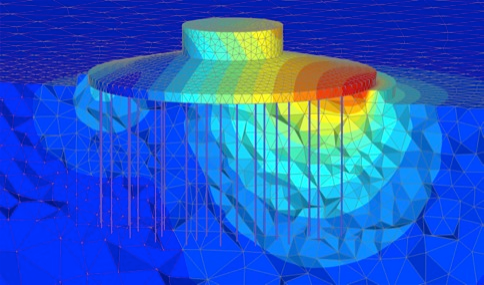
The best sites for wind conditions can present challenging ground conditions, including steep slopes and compressible strata. The design may therefore require measures such as piled foundations.
Wind action on a tall tower produces a large overturning moment at foundation level relative to the vertical load. Excessive foundation rotation can affect efficiency and safety. For the types of turbine considered here, manufacturers often specify a serviceability rotation limit of around 3 to 4 milliradians.
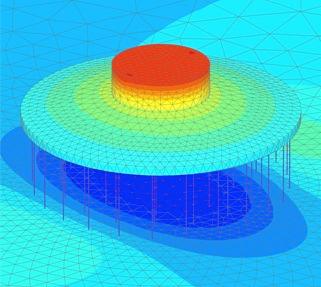
Serviceability checks generally require advanced analysis to represent interaction between the foundation and underlying soil layers.
The choice of soil constitutive model depends on the ground conditions. The analysis can account for non-linear soil behaviour, primary consolidation, creep, swelling, collapse on wetting and other mechanical or hydraulic effects relevant to short- and long-term soil–structure interaction.
Contact between the soil and structural elements such as piles and the foundation slab can be represented by contact algorithms or interface elements. These avoid making the shear band at the contact dependent on the mesh discretisation. The interface is generally modelled as elastic–perfectly plastic.
Horizontal loads and the large overturning moment make the problem inherently three-dimensional.
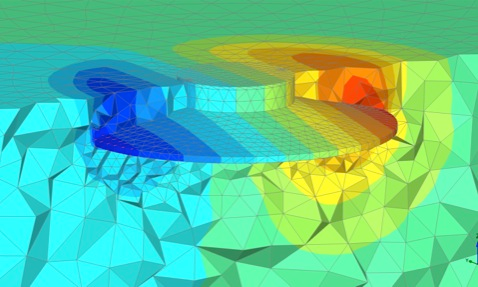
WeSI Geotecnica has developed design and verification models for wind farms in Europe, the United States and Latin America. These have covered stability and serviceability across ground conditions ranging from intact rock to expansive and collapsible clays and silts, including loess.

WeSI Geotecnica Srl
Since 2009
Piazza de Gasperi, 15/11
54100 Massa (MS) - Italy
Tel. +39 0585 44824
Via di Sottoripa 1A/84
16124 Genova (GE) - Italy
email: info@wesigeotecnica.it